


I must admit that I am having a hard time understanding Jill Stein's end game in asking for a recount in Wisconsin, and possibly Michigan and Pennsylvania (with support from the Clinton campaign).
Hacking the vote
People have been asking me whether it is technically possible for a third party (or nation state) to hack voting machines and affect a national vote, one of the ostensible causes for Stein's request of a recount. My answer is that, technically, of course this is possible ... and we even know how!
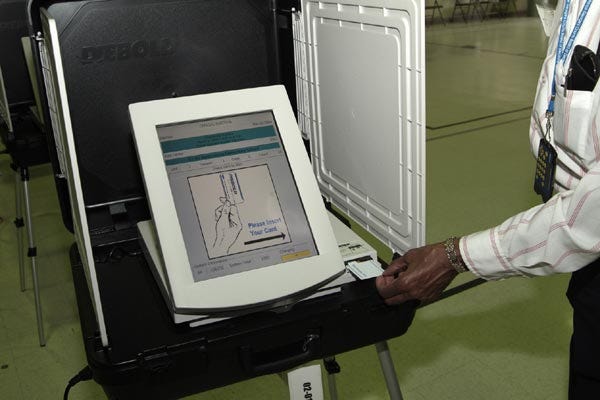
Notwithstanding the Obama administrations assurances to the contrary, there is research dating back ten years outlining the weaknesses of electronic voting in this country, including systems with:
Proprietary, closed-source software that cannot be vetted (by the public) for vulnerabilities.
Central code source that, if compromised, could naturally lead to a compromise of a large swath of machines.
No paper backup of voting records that could be used to forensically detect and/or correct voting irregularities.
Poorly controlled physical access to voting devices, which could allow infiltration and manipulation of their code.
Indeed, several prominent security researchers, including Schneier and Halderman, have recently written about how such hacking could occur today.
Detecting a hack
Would a recount of votes be able to detect electronic hacking of these machines? I do not see how! Without a paper backup of machines, there are really two main methods for attempting to detect an anomaly:
Statistics - like those that Halderman (above link) utilized to sound the alarm up front. These approaches could look, for example, at statistical anomalies between votes cast in areas with similar demographics that differ in voting method (i.e. one with electronic machines and the other with paper voting). Such analyses are fraught with the challenges of controlling for differences between similar populations (i.e. how do you know that the two areas are similar enough in their voting for this election) and the results are, ultimately, only as accurate as the underlying models on which they are based. Furthermore, such an analysis does not require a recount, as the data is already available!
Forensics - looking at the physical hardware of the machines for signs of execution of malicious code (or, potentially, looking for forensic evidence on the transmission route to the voting machine). Again, this is a very tedious and difficult process, since any reasonably sophisticated malware would erase itself (and its tracks) once it has accomplished its goal. Recovering properly erased data is also an extremely tedious process, requiring manual access and possibly manual analysis of each potentially compromised machine (and many false positives that are not compromised). In short, this is also largely infeasible on a mass scale in the given time constraints.
Cui bono
Who stands to gain from the election recount? Consider the possibilities:
Trump is reconfirmed the winner - In this case Stein has just wasted $5 million and a whole lot of time on an effort that seemed doomed from the start (certainly, no one in their right might expects Stein to have any chance of being declared the victor!). Clinton, by supporting the recount after having conceded publicly, has demonstrated a lack of confidence in the election that undermines the peaceful transition of power.
Clinton closes the gap - or has a Trump moment and seizes the presidency from the jaws of defeat. Given the level of rhetoric during the campaign (both from the candidates and from their supporters), I can imagine that the protests and violent rallies we have seen so far are likely to significantly intensify and threaten an even broader cross-section of the country. Trump is likely to mount a legal challenge, which will certainly go to a divided (and not impartial) Supreme court ... and the result is that there will be significant turmoil and doubt about who will be the next president.
Silver lining
On the positive side, perhaps this snafu will finally push for a tightening of voting security, after all Ed Felton, one of the authors of the early voting machine vulnerabilities, has been Obama's deputy CTO.
Based on what we've seen over the last ten years, I would not hold my breath.